
Making Mobile Roaming Easier in East Africa
5th February, 2026
The One Network Area (ONA) Initiative was created to make mobile roaming across East Africa simple and affordable. The idea is simple: when you travel within the region, your phone works just like it does at home, and incoming calls are free.
However, not everyone enjoys these benefits equally. Differences in rules, market practices and network readiness mean that roaming services still vary from one Partner State to another. These bottlenecks continue to create inconsistencies in the ONA experience across participating countries. Key challenges that must be addressed to achieve a seamless and harmonised ONA experience include:
Policy Challenges
Policy and regulatory misalignments remain a major barrier to the seamless implementation of the ONA. Differences in national frameworks, pricing structures, and regulatory enforcement continue to slow progress toward a fully harmonised regional roaming environment. Key policy and regulatory challenges affecting the implementation of ONA include the following:
- Enforcement of ONA: Uneven application of roaming rules across the Partner States reduces the predictability and quality of service for roamers.
- Asymmetric retail pricing: Home users calling roaming subscribers often pay full international rates while roamers receive free incoming calls, creating unfair costs and discouraging cross-border calling.
- State-controlled traffic gateways: Mandatory routing through government-operated international gateways often increases costs.
- Divergent tax regimes: Differences in taxes on voice, SMS and data across countries complicate tariff harmonisation.
Market Challenges
Market dynamics and commercial incentives among operators and users also influence the effectiveness and sustainability of ONA. Variations in pricing models, traffic flows, and competitive positioning create imbalances that can undermine fair participation and long-term adoption. The main market-related challenges shaping the ONA landscape include:
- Permanent roaming misuse: Long-term use of foreign SIMs exploits lower roaming tariffs and abuses the ‘roamer’ status.
- Traffic routing and transit fees: Additional interconnection charges through international carriers increase the cost of roaming.
- Cost imbalances between operators: Differing tariffs and fees create an uneven playing field, discouraging full participation in regional roaming.
- Unequal incentives for users: Some users take advantage of cheaper roaming options while others pay more, undermining trust in fairness and slowing overall adoption of ONA services.
Operational Challenges
Operational constraints across networks continue to affect the quality, reliability, and efficiency of ONA services. Differences in infrastructure maturity, connectivity arrangements, and system capabilities lead to inconsistent user experiences across borders. The key operational issues affecting the delivery of seamless ONA services include:
- Uneven service quality: Network performance vary across national borders, affecting user experience.
- Limited network capabilities: Some national networks lack 4G/5G coverage, restricting access to advanced roaming services.
- Weak cross-border connectivity: Routing traffic via international carriers causes delays, inefficiencies and higher costs.
- Billing and fraud risks: Complex billing, delayed settlements and weak regional fraud detection lead to revenue loss and discourage roaming.
How EARDIP is Helping
EARDIP is taking a comprehensive approach to strengthen the ONA initiative through development of a regional roaming framework. At the policy level, the project aims to develop a framework that harmonises rules on interconnection, roaming tariffs, quality of service and enforcement, creating a fair and predictable environment for operators while protecting consumers. On the operational side, EARDIP aims to promote efficient cross-border call routing and interoperable billing and settlement systems, ensuring accurate charges, reducing inter-operator disputes and improving service reliability for users.
By addressing the policy, market and operational gaps, the proposed EAC Regional Roaming Framework, designed to reflect evolving technologies and market realities, has the potential to make mobile communication across East Africa more seamless, affordable and reliable. These improvements are critical enablers of the free movement of people, goods and services as provided for by the EAC Common Market Protocol.
DOWNLOADS:
INFOGRAPHIC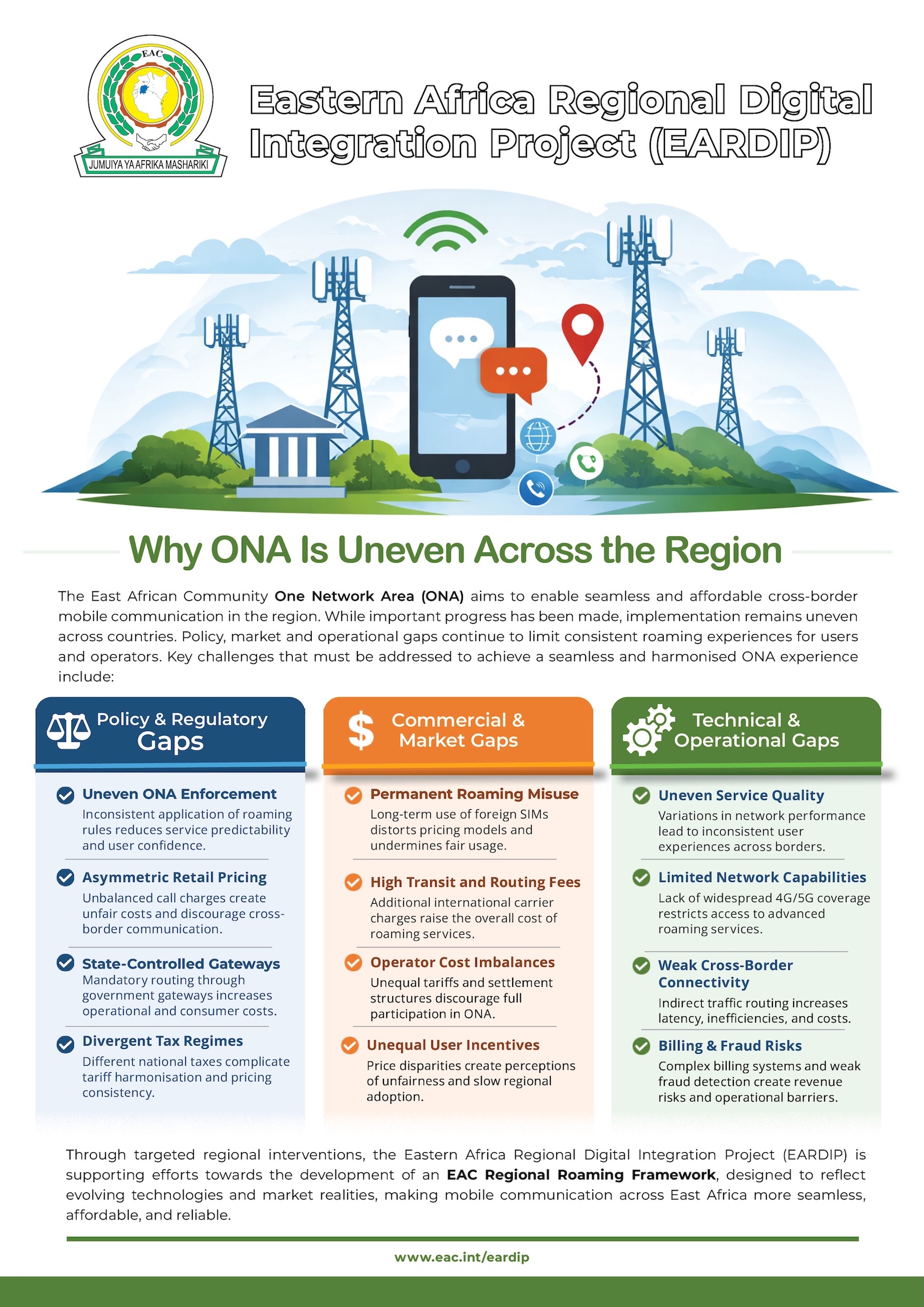
Tags: #EARDIP